

Understanding Conservation Law Enforcement in Conflict Zones

Updated: May 18, 2020
An eastern Democratic Republic of Congo (DRC) case study.
Let’s set the context:
Between 1950-2000, over 80% of major armed conflicts took place directly within hotspot areas, most suffering repeated episodes (Fig. 1). As of 2014, 70% of conflicts that began in 2000, continue on to this day. Okay, so? Well, in the best of cases this can actually lead to important wildlife buffer zones, mini havens for the region’s biodiversity, for example the Demilitarised Zone between North and South Korea. It can also lead to reduced economic activity, allowing exploited natural resources to recover. However, armed conflict can also have serious environmental and social ramifications.

In times of heavy conflict, Protected Areas (PAs) are increasingly becoming primary sites of a move towards what is called ‘green militarisation’. A term coined by Elizabeth Lunstrum (2014), which essentially defines the use of military like or paramilitary actors, technologies and techniques in the name of conservation. There are three main drivers for this shift that serve as (un)official justifications:
Conservationists must be able to defend themselves and the wildlife from armed factions who will often use PAs for cover and their natural resources to eat or sell;
It is considered an important method to reduce poaching;
It can reinforce State authority over people and resources.
What does this have to do with eastern DRC?
The Eastern parts of the Democratic Republic of Congo are plagued by ebbs and flows of violence, militia groups, poverty and political instability (Fig.2); the origins of which are complex but link to the Rwandan war (1990-1994) when over 1 million Hutu Rwandan refugees fled into the area. This was followed by two devastating wars in the mid-90s and early 2000s which very quickly turned from being political to profitable. Why? Because despite being one of the poorest countries in the world, the DRC is also one of the most biodiverse and resource rich (Fig. 3).


So repeated armed conflict + eastern DRC PAs = a problem situation.
These images are just a few of the recent clashes and conflicts in the DRC’s PAs, mostly located in eastern Congo. Environmental defenders are being killed, tourists have been kidnapped, conservation law enforcement actors are being accused of partaking in illegal and violent activities against locals, clashes between locals and rangers are resulting in deaths, and international donors are beginning to remove their funds and support as confidence in the conservation community declines.

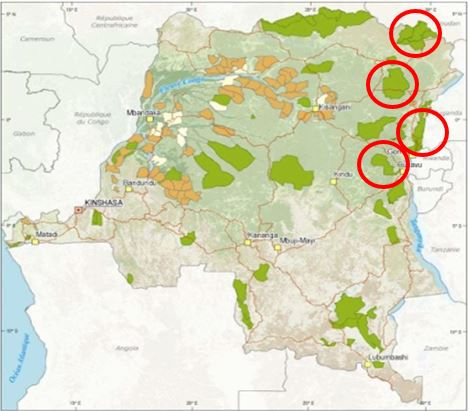
In light of decreasing support, escalating violence and recent human rights abuses as they affect biodiversity conservation, I used the critical system heuristics methodology (CSH), using boundary critique to undertake a critical analysis of conservation law enforcement in four protected areas in eastern DRC: Garamba National Park, Virunga National Park, Kahuzi-Biega National Park, and the Okapi Wildlife Reserve (Fig. 4). All of which are UNESCO World Heritage Sites and fall under category II of the IUCN Protected Areas.
The technical bits: Critical Systems…what??
Critical Systems Heuristics, as developed by Ulrich in 1983, falls within critical systems thinking (CST) research and can be used to better understand conflict between stakeholders in complex social situations. Conflicts can arise because individuals are bound by the limits of what they can understand; no one can have a ‘God’s eye view’. So, people form ‘boundary judgements’: what they deem as relevant (or not) to a system of interest. These boundary judgements are based on the facts they observe (consequences of a proposed action) and the value judgements they make (intended purpose and beneficiaries) – cue the sophisticated triangle in Fig. 5. In Critical Systems Heuristics, boundary critique is conducted using a set of 12 boundary questions that explore motivation, control, knowledge and legitimacy of a system (Fig. 6).


I remotely conducted 25 in-depth interviews with a range of stakeholders from academic, practice, and government backgrounds in human rights and conservation fields, and local and indigenous community members. Interviews were analysed qualitatively through boundary critique and open coding methods.
Boundary Critique
Source of Motivation:
Wide consensus among stakeholder groups that the purpose of conservation law enforcement should be to protect nature and stop illegal activities
Several participants also suggested it be part of a broader strategy for post-reconstruction in Congo.
Widespread agreement that the beneficiaries should be nature, the local community, or both. However, what was revealed under “Sources of Legitimacy” is that the local community do not see themselves as beneficiaries.
Sources of Power:
Most participants agreed that limiting factors to decision making abilities included the violent history, weak government institutions, continuing conflict, and lack of rule of law in Eastern DRC.
Widespread agreement that the main decision makers are international NGOs and the Insitut Congolais pour la Conservation de la Nature (ICCN), a semi-government authority in charge of the management of the PAs in the Democratic Republic of Congo (DRC), and that they have control over the main resources.
However, the majority of stakeholders, (interestingly) bar the national public authority, advocated for community empowerment and bottom up approaches.
Division among participants becomes obvious in relation to the role of the international donor. Conservation practitioners and government authorities viewed it as necessary for the success of conservation law enforcement, academics and local community members viewed their involvement as unjustified, neo-colonial and as perpetuating dependence on foreign aid.
Sources of Knowledge:
While paramilitary, legal, and ecological knowledge appeared to be prioritised there was a general understanding that not including social and cultural knowledges could further marginalise the local community from decision making.
Sources of Legitimacy:
Widespread acknowledgement that the local community were marginalised in various ways and that platforms for representation were artificial and did not amount to a change in the power structures, despite the fact that several decision makers believed the local communities were included.
Rebel groups were understood by some participants to be exploiting local individuals and groups who came to rely on them for their livelihoods and access to resources.
There was widespread agreement amongst stakeholders that law enforcement loses its legitimacy when there are human rights abuses and when the laws are not ethically or legally just.
Academics, local community members, and human rights stakeholders believed another source of illegitimacy is linked to the fact that marginalised groups cannot hold the international decision makers and donors accountable in the way that they could hold their own publicly elected government.
So, what does this actually mean in the wider context?
In 2017, Midgley and Pinzon reported that if conflicts are not addressed, they can become entrenched. The top-down, neo-colonial approach to conservation law enforcement is perpetuating perceptions and practices of unequal power for the local communities. Continued disagreements are ill-resolved and the findings indicate that local community members must simply accept decisions imposed on them by decision makers. These conflicts are further entrenched for the fact that international decision makers and donors cannot be held accountable by the local communities in the same way that a publicly elected body could and this links in with growing literature in relation to the ‘supra-national’ management structures of PAs.
Another important finding indicated that despite the responsibility of the international community towards the UNESCO World Heritage Sites, their involvement in conservation law enforcement may be reinforcing the DRC’s dependence on foreign aid and actors, extending practices of ‘extra-state territorialisation’. In at least two of the PAs, international actors impose policies and enforce the law in a way that territorialises control over the PA, extending neo-colonial conservation practices that exclude the local community and maintain extra-state control over the resources and people.
Lastly, as the local and indigenous communities are unable to rely on the Congolese government and feel marginalised by the conservation community, some have found support in armed rebel groups. Similar to previous research by Verweijen & Marijnen (2018), the results of this study indicate these relationships are complex. Local communities must pay ‘fees’ or undertake in illegal activities in return for protection and access to the PAs resources. The local communities then protect the rebel groups on whom they rely, by refusing to offer intelligence information or support law enforcement actors. So, on deeper analysis it seems that authority in the PAs is unofficially but ultimately legitimised by the local community, who by protecting the rebel groups, on who they rely, legitimise their authority and control of PAs over conservation law enforcement actors. Though marginalised, the local community, thus, do hold a certain power.
Future recommendations:
Provide spaces for real representation of local and indigenous community members; places they can access easily, where they feel heard, and are represented by members they elect for themselves.
Create opportunities and platforms to hold the international community to account and ensure greater transparency of their involvement in conservation law enforcement in eastern DRC.
Ensure that the international community are involved in conservation law enforcement with the goal of capacity building. They should, as a priority, be focused on transferring skills and expertise so that in the long-term, conservation law enforcement can be part of post-reconstruction strategy in Congo, led and executed primarily by the Congolese State.
Local communities must see themselves as included in and benefitting from conservation law enforcement if they are to support it. An important aspect of this is the provision of alternative livelihood opportunities and true participatory opportunities.
Given that the majority of armed conflict overlaps with biodiversity hotspots, improving our understanding of the complex social and environmental dynamics that conflict generates can assist in the creation of effective, long-term conservation strategies.

Kathleen Drake


Comments