

Reporting Quality of Social Science in Conservation Journals and Factors Affecting the Standard

Updated: May 18, 2020
It has been increasingly recognised that to be able to find solutions to often human related conservation problems an interdisciplinary approach must be taken, utilising the social sciences where natural sciences alone are insufficient. However, integration of the social sciences into conservation continues to be a struggle and there is a perception amongst those in conservation that the social sciences used in the field are executed poorly. Vital to the ability to assess the standard of social science being conducted is for it to be reported in a transparent, reliable, and replicable way.
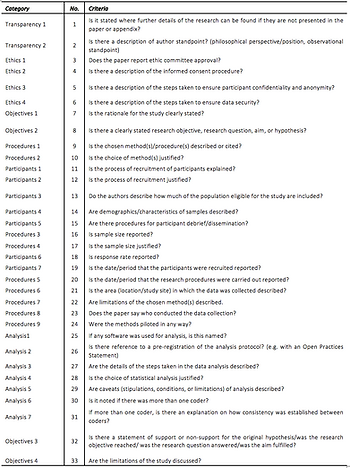
After a literature review and document analysis, I developed 33 best practice criteria (Table 1) to assess the current standard of reporting of social science. I focused on papers published in 2018 from 7 conservation journals (Animal Conservation, Biological Conservation, Conservation Biology, Conservation Letters, Environmental Conservation, Journal for Nature Conservation, and Oryx). I also investigated the potential factors affecting the standard. These were page length, the number of social scientists authoring a paper, study type (quantitative or qualitative), publishing journal and author affiliation (eg. NGO or University).
107 papers published in 2018 across seven conservation journals were assessed and found to report social science inadequately (Figure 1). It was found that information vital to the understanding and reliability of the research as well as its ethical acceptability were lacking, and raised questions about both the education and training of those writing the articles and those allowing them to be published.

No single factor was found to influence the standard of reporting, although some did affect individual criterion, but some key ways to improve the standard emerged:
The education and training of those entering the field of conservation must include best practice reporting guidelines and at minimum, awareness of social science methodologies and what needs to be considered when utilising them.
The journals that publish social science papers need stricter guidelines on what they expect to be reported in papers and to make sure these are enforced to the same extent as the reporting standards and demonstrations of methodological rigor in papers with an ecological or natural science focus.
The reviewers and editors of these papers need to be adequately educated in what is required when reporting social science in order to ensure these guidelines are enforced and understood. Convening an expert working group to establish a common set of guidelines across journals, could be used to ensure reviewers know what they are expected to be looking for in social science papers.
In order for progress to be achieved in the field of conservation it is key that social scientists and their knowledge are incorporated into both research and field work. Although we are seeing an increase in the number of social science papers published, which may indicate progress in the inclusion of social science in conservation science and practice, it is imperative that these papers are held to a high standard of scientific quality, equal to that of natural sciences.
The results of this study show that the social science in conservation is not being reported adequately even at some of the top journals in the field and that improvements can and need to be made. The poor standard of reporting has implications as it furthers the problem of a lack of replication of studies in this field as the details required to do so are lacking. The quality of these papers may also set a precedent of acceptable quality to others, and perpetuate the cycle of an inadequate standard of reporting.
Ultimately, in order for journals and institutions such as universities to make changes, there needs to be an incentive for them to do so. Further calls from the wider conservation community for these measures be put into place is necessary as the current state of reporting is limiting the reliability, usefulness, and ethical acceptability of research.
Holly Paget-Brown
E: hpagetbrown@gmail.com


Comments