

Shaping ideas and projects at a local level

March 2020. Lockdown. I had witnessed first-hand the huge increase in people exploring their surroundings as a response to the restrictions on travel. Resolved to open my neighbours' eyes to the fantastic wildlife around them, I committed to sharing where, when and how to look for it. I have always been passionate about our native British species, but this proselytising mission was new ground for me. I shared photos and stories of wildflowers, reptiles, raptors, butterflies. All the things that made me stop and stare in wonderment during my daily exercise I posted on my local community social media. I hoped that I could inspire others to care and learn about the pressures facing wildlife here in our little town.

My activities attracted the attention of Ronnie Kendall, the inspirational chairman and driving force behind the Community Workshops & Gardens at Holme Farm (CWG@HF) project. Ronnie had been working on a proposal to lease a derelict farm from the government, which had long ago slipped into disrepair and eventual abandonment. Ronnie had grand plans to turn the rundown buildings into kitted-out workshops, classrooms and a café. People of all ages would be welcome to come and learn new skills, make new friends and fight the modern epidemic of loneliness. But Ronnie had no experience when it came to managing the accompanying fields and so asked if I'd like to be involved in some capacity. We immediately clicked over our shared belief in the power of nature as an agent for improving human health – physically, mentally and socially. His background in working with youth groups had taught him how vocational activities could help young people find their place and value in the world, and I've long been an advocate for reconnecting young people with nature. Equally, during my lockdown mission, I'd been shocked by the number of adults who were unaware that we had wild reptiles in the UK or had never seen a kingfisher. Without a second thought, I agreed to become the committee member for biodiversity, and was given free rein to create somewhere of benefit to both humans and wildlife.
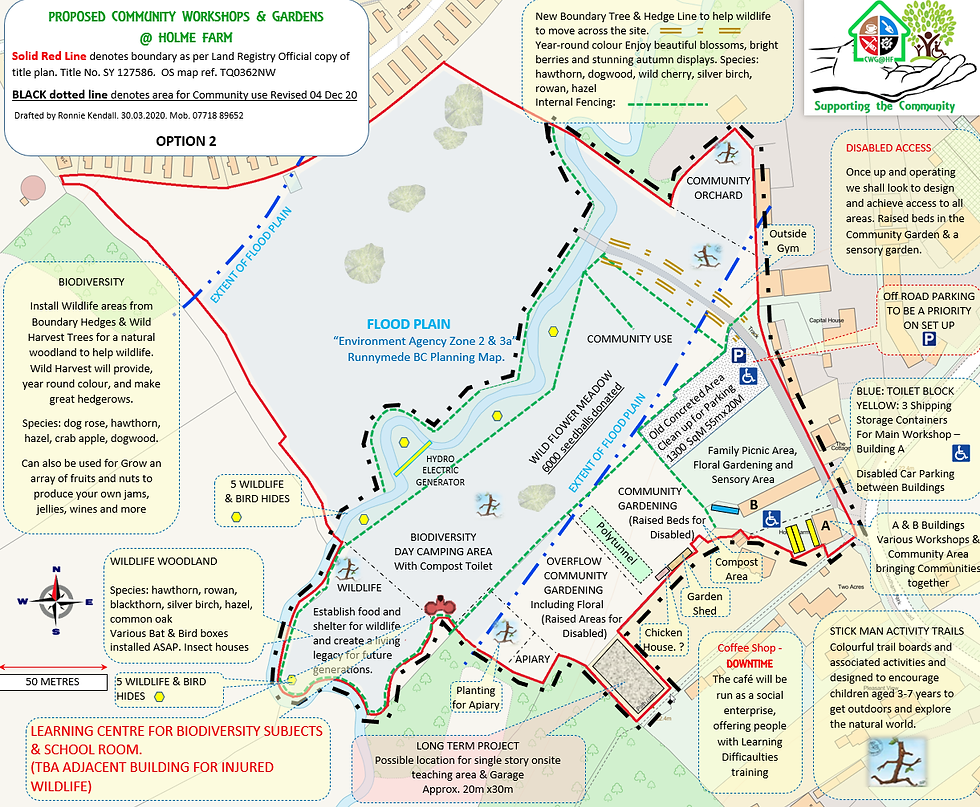
Holme Farm is a 5.6-hectare plot of ex-pasture on the banks of the River Bourne in NW Surrey. As part of the river's floodplain, it is prone to annual winter floods which makes it unsuitable for development. The surrounding area is suburban, patches of woodland interspersed with housing, and the large conurbations of Woking and Addlestone are both within a 10-minute drive of the site. Chairman Ronnie learned that Defra are seeking to sell the farm in an effort to raise funds. He theorised that planning permission would never be granted to build there due to the floodplain. This spurred him to formulate his idea to lease it to the community instead and benefit local residents. Through his dogged persistence, we now have local councillors and even MPs onboard and, whilst discussions are ongoing, the chances are high that we'll be successful in obtaining the land very soon.

I have never been responsible for managing land before, so it has been a case of learning on the job, while drawing on the lessons learned during my conservation science degree. I have been utilising social media to engage with the community and build enthusiasm for the project, switching between technical and non-technical language depending on the target audience. I recently had an article published in the borough newsletter, circulated to 10,000 homes, thus reaching an audience that relies on traditional, rather than digital, media. With every communication, we canvas for opinions and ideas from our supporters and stress that this project is community driven. This approach has helped to foster a sense of ownership amongst our supporters and we've received a number of suggestions that have now made their way into our plans.
My passion for reconnecting the public with nature has led to ambitious plans to run BioBlitzes and ongoing species surveys, among plenty of other activities, all of which assist with our monitoring efforts. Most importantly, it will also provide an opportunity for people who are detached from nature to experience wildlife up close. We will also be using the CWG@HF project to train people in species identification and ecological techniques – skills that may benefit them if they choose to follow a nature-based career, or simply enable them to better enjoy wildlife in their own time. We plan to run nest cams and camera traps offering people an insight into the lives of our resident wildlife and will have educational signage and trails to follow helping them to learn about nature and the threats it faces. Top of my agenda is running activity days and classroom sessions for young people to lock in a lifetime fascination and care for the environment.

In seeking out experience and local knowledge, we've cultivated partnerships with naturalist groups, NGOs and local government. Having been a member of my local herpetology group for many years, I was familiar with their work and volunteer surveying activities, but this project has opened my eyes to the diversity of citizen scientist naturalists out there. Local societies exist for botany, bats, birds, moths and more. By reaching out to them to explain what we are doing at CWG@HF, we've secured the support of enthusiastic naturalists who will visit and help us to establish a species list for the site, provide talks and educational support and assist with ongoing monitoring. I've spoken at length with ecologists and land managers who've undertaken similar projects so that I can learn from them and share best practice going forward. Via the county biological records team, we've secured species reports for our surroundings which have enabled me to create GIS maps of the site to aid our management planning. We have agreed that the records we generate on site will be fed back in to the recorders to likewise assist with countywide conservation planning. Reaching out to neighbouring landowners has secured us insights that could only be gained from those with an intimate knowledge of the area itself. There's also much to be said for online communities which are an amazing resource for connecting with like-minded individuals who have already been through the process and can provide a wealth of knowledge and direction based on their own experiences.

Funding, as ever, is the most difficult aspect of our project. Fortunately, the CWG@HF project as a whole has additional facets outside of conservation which allows us to approach grant applications from multiple angles. At present, grant applications focus on the human benefits to be gained from our plans, although this absolutely encompasses benefits to nature as well. We are an attractive prospect for funding and support from local government; we offer access to local greenspace in keeping with social distancing and travel guidelines as well as overall health benefits from being in nature. Once we have established ourselves and proven our viability, our focus on connecting people with nature will aid us in winning grants from conservation funders too. Additionally, local businesses have been willing to offer their services to us at greatly discounted rates in recognition of the fact that we are a local charitable project, which goes to show the benefits to be gained from emphasising your community links when engaging in this type of project.
What began as me agreeing to help a charitable project in my hometown has evolved into something that I'm incredibly passionate about. It's given me the opportunity to talk to people I would never have otherwise met and to put into practice a lot of what I've been taught during my degrees. On a professional level it's provided real-life experience for my CV – and was integral to my recent job-hunting success. Beyond that, though, it's given me a sense of achievement and an opportunity to give back to my community.
I'd encourage any budding conservationists out there to seek out opportunities to help shape ideas and projects at a local level. And for established conservationists, I can't stress strongly enough the importance of offering your expertise to make a real difference on your local patch. We should all be engaging our own communities in conversation about the wildlife on our doorsteps. As the great Sir David Attenborough said, “No one will protect what they don't care about, and no one will care about what they have never experienced”.
Knowledge of the natural world continues to fall amongst the UK population. Conservationists and ecologists are equipped with the knowledge and skills to inspire future generations to follow in our footsteps, which can only benefit our native wildlife and habitats. My personal hope for the project is that the groundwork we lay now, in terms of building enthusiasm and providing vocational training, blossoms over time into a team of knowledgeable and committed volunteers. I hope that they take charge of their own sub-projects on the land and use their experience to drive other community land acquisitions in the future.
By Andi Roy


Comments