

Transformative Change: Creating Change

Transformative change is forming systems and societies that are different to the status quo. Here, we present a series of four blogs regarding this topic: i) The system, ii) The system and nature, iii) The alternatives, iv) Creating change.
We recognise that this series is influenced by our own lived experiences. For full disclosure, these lived experiences have taken place in the Global North, by two white women. We fully acknowledge others have had, and continue to have, different experiences and we would love to open up a discussion around how we can make transformative changes that are just and sustainable.
We would first like to acknowledge the recent events happening in America, and around the world, that haven’t only been happening this week, but happen everyday. We stand in solidarity with the BIPOC community. Your fight is our fight.
Key points
We propose building the foundations of change within oneself first, by getting comfortable challenging the status quo, and our own thoughts and actions.
In addition, recognising power dynamics and understanding where they come from is crucial.
Once inner change is underway we can turn our attention to the world around us.
We believe transformative change is possible by using privilege for good, for example, to leverage marginalised voices; becoming an activist, either in the streets or not; and challenging the mainstream media.
Recognising the need for new terminology, accepting and learning from failure and creating diverse solutions that use new ways of thinking are explored.
We advise thinking global, acting local and starting small.
The three previous articles discussed the history of capitalism and neoliberalism and their relationship with nature; the detrimental effects of the nature-society dualism narrative and our obsession with economic growth; and alternatives to the status quo, looking specifically at democracy, economics, ways of living and nature conservation. In this concluding article, we give suggestions for how you can be a change-maker. We will begin with recommendations of how you can establish change within yourself; we believe this is a necessary first step. Then we will propose actions you can take to actively move towards transformative change. Lastly, we’ll explore some final points relating to terminology, failure and solutions. To start this journey we turn to anarchy. Anarchy is often misrepresented as chaotic hooliganism, focused on destruction. However, anarchism is defined as a range of views that tend to be sceptical of domination and hierarchy. It requires those in positions of power to justify their authority, through the recognition that authority is not self-justified. If they cannot justify their power and control, the authority of the system, then the system should be dismantled and replaced by something more free and just. Fundamentally, anarchy seeks to challenge the status quo.

This is important because as we saw in Article 2 the current status quo sees economic growth as the main aim and perpetuates narratives of a nature-society dualism, which are detrimental for the planet and people. Challenging the status quo should be applied universally to interrogate existing power dynamics between people, people and the system, and the nature-society dualism. As we discussed in Article 2, by overcoming the narrative of a nature-society dualism we begin to recognise that truly holistic solutions, solutions that incorporate political and economic justice and equity, are needed to fight against environmental degradation. We must recognise that the problems are intertwined: climate justice is racial justice is gender justice is economic justice. Within this process, we must also challenge ourselves. What language do we use that perpetuates a nature-society dualism; what negative everyday behaviours do we commit against Black, Indigenous and People of Color (BIPOC), intentionally or unintentionally; what assumptions do we make about those who are less privileged than us? This can be uncomfortable but you don’t get growth without growing pains. It’s the recognising, acknowledging and taking action that matters.
When we start to feel more comfortable with challenging the status quo and ourselves, we can question and imagine. We want to save biodiversity, but what is that? What does ‘biodiversity’ mean? We want a just world, who will this benefit? By questioning what we fundamentally value, breaking down these large concepts into manageable pieces, and imagining what the alternative will look like, we can more easily put pragmatic steps in place to get there.
Getting better at seeing power is also important; where it lies and how it influences interactions. We can only begin to dismantle these power dynamics if we start to recognise them. For example, the domination and exploitation of the Earth, women, African, indigenous and other peoples enabled the West to grow in power. Although the colonial roots of the West are now in the past, its legacy is still alive. We have seen numerous examples of organisations from the Global North pushing solutions upon the Global South. We believe this is wrong. Those in the Global North should be asking how can they help, not assuming that their solutions are the ones needed.
Once change within yourself is underway (feeling comfortable challenging the system, yourself and power dynamics), it’s time to start trying to transform the world around you. It's time to take action. Privilege bestows power. We believe it’s an individual’s responsibility to use that privilege, if they have it, to fight sexism, racism, ableism, inequality, climate change, habitat loss and biodiversity loss. This may sound a little overwhelming, but as we’ve discussed, these issues are one. Hence, when we work towards saving the Earth, we can incorporate other acts of justice. For example, when hiring, guarantee any BIPOC who meet the essential criteria an interview (this is especially important within the environmental sector as it’s the second least diverse sector in the UK). As with racism, we must take the same steps to actively combat sexism and ableism and other forms of discrimination and inequality if we want a just and sustainable future. Those in privileged positions can also use their purchasing power to buy sustainable goods, for example, Forest Stewardship Council-certified wood and paper products. However, we believe this is not enough, we need to counteract the narrative that the consumption of material goods, and consequent production of emissions, inherently makes us happy and is needed for life to go on (this is line with degrowth, which we explored in Article 3). This can be done by living a more frugal lifestyle through limiting the amount you consume, for example, technology and clothes.

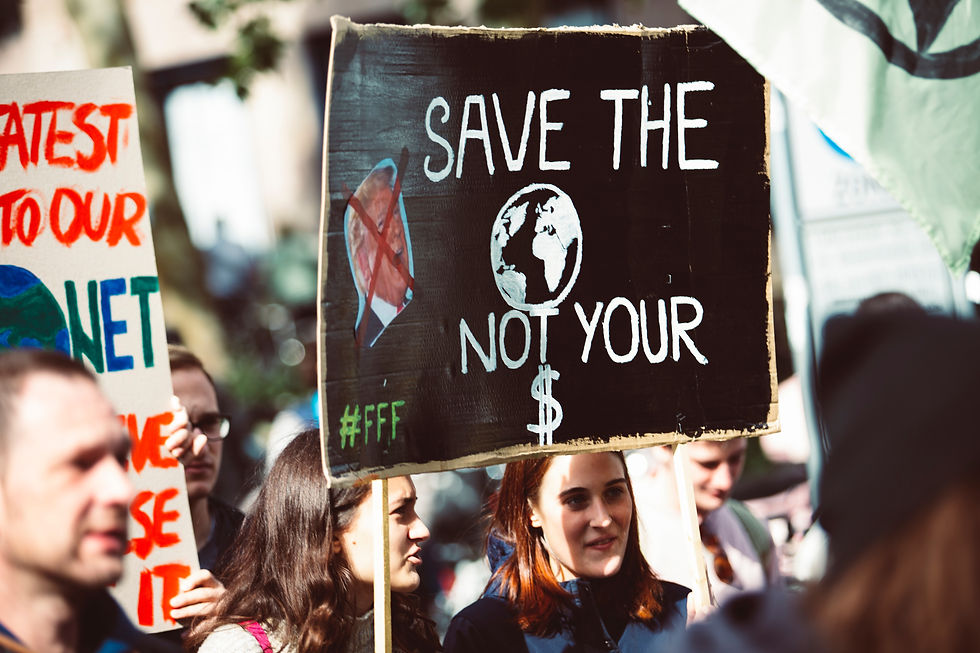
As rejecting the nature-society dualism tells us, these kinds of choices not only impact the environment, but also our fellow human-beings. With 24 million people displaced by weather-related disasters last year, this figure is only going to increase as the effects of climate change worsen. As Gandhi said: “Live simply, so others may simply live.” These actions are only half the battle. We must recognise that although personal lifestyle changes are beneficial, it is the system and prevailing institutions that ultimately need to change. As we spoke about in Article 1, part of the neoliberal approach is to roll back the state and focus on individualism, this results in the idea that the burden of responsibility falls on the individual: ‘YOU need to shower less, YOU need to recycle, YOU need to drive electric cars’. This isn't the whole truth! One of the most important ways to challenge the system is through activism. Activism consists of efforts that work towards social, political, economic and environmental reform, for the aim of societal change. Activism proves that collective power can be immense (something we often forget). What would the world be like now without the women’s rights, civil rights and the 1960s and 70s environmental movements? This gives hope for the future. What more can we achieve? Activism can take many forms. A recent example of activism in the UK is the Extinction Rebellion movement. This involved occupations, protests, roadblocks and individuals gluing themselves to buildings, among other activities and resulted in the formation of a Climate Assembly, enabling citizens to make recommendations to the government regarding climate targets (this is an example of the participatory processes we spoke about in Article 3). As seen, direct action can and does produce results, but this kind of action isn’t the only way you can engage in activism and create change. You can engage with policy by writing to your MP, joining a union or even becoming a politician. Become an activist in your community by providing a safe space, sharing your passion and thoughts not only on your social media, but also through your local media outlets, and connecting those in need with the resources they require. The words most often attributed to Thomas Jefferson say it all, “When injustice becomes law, resistance becomes duty.” and all these actions are acts of resistance against injustice.

For us, creating transformative change, also involves challenging the mainstream media. In theory, the media should facilitate “a horizontal exchange of ideas and views” to create a space for discussion and debate. It has a responsibility to inform the public, as an informed public is an empowered public. However, the UK mainstream media is being increasingly criticised for its vested interests and biases, which results in the top-down dissemination of information that cannot be challenged. This ranges from influencing consumer’s political beliefs by providing a biased account of parties and their leaders to the lack of direct questioning of prevailing economic systems. The mainstream media can also proliferate fake news and post-truths. Noam Chomsky and Edward Herman argued that the media works as a propaganda machine manufacturing the consent of the masses to benefit those in power i.e. governments and corporations. To challenge the mainstream media you can support alternative and independent media and local news outlets through readership, but also financially, if you’re able. You can educate yourself and others about this issue and encourage awareness. You can even vote for political parties that actively try to combat this, for example, in Finland fact-checking training, which includes developing critical thinking skills and increasing news literacy, takes place in schools.
Whatever positive actions you choose to take to create transformative change, talk about them with your family, friends and work colleagues. This will motivate and inspire others and create new social values and norms within society. These new social values and norms can encourage policy makers to adopt ‘radical’ policies, through the shifting of public acceptance (i.e. the model of Overton’s Window).
So, we have spoken about becoming comfortable with challenging the status quo, educating ourselves and envisioning alternatives, using our privilege and mechanisms, such as activism, to create change, and the need to understand how the media can promote justice or suppress freedoms. Here, we briefly explore thoughts relating to terminology, failure and solutions.
Terminology
While writing this series we encountered a distinct lack of English vocabulary to describe certain concepts. For example, there is no one word which explicitly encompasses both nature and society. It’s debatable that terms like ‘planet’ or ‘Earth’ could be used, but due to the entrenchment of the nature-society dualism within Western society, we feel this may lead readers to think of nature, and not society. This deficit should be addressed.
Failure
We are taught to avoid failure at all costs. We’re told, if you don’t, bad things will happen. We believe this systemic fear of failure is counterproductive. We need to acknowledge our past failures, their repercussions and explore why they happened, in order for them not to be repeated. For example, the aviation industry has a rigorous and adaptive approach to failure. When this was adopted by a US hospital, insurance costs decreased by 74%. Fear of failure also stifles our future actions. What if we get it wrong? That’s okay, failure is part of learning, as is shown by the example above. How will we know what works and what doesn’t if we don’t even try? Trying and failing is better than not trying at all. (We’re aware that in the context of transformative change, failure could, and most likely will, have implications for nature-society, as will inaction.)
Solutions
We recognise that working towards a global transformation will need localised solutions that take differing contexts into account. There is no silver bullet. With regards to solutions abroad, we believe these should be decided upon by local communities themselves. If international organisations wish to provide assistance, the form of that help should be decided by local communities. When decisions are made globally, these should be inclusive of marginalised voices.
A myriad of alternative solutions growing from different contexts will create valuable diversity on a global scale, though some consistency of, for example, economic systems may be more appropriate at a local or regional level. This global diversity will enable redundancy, meaning if one pathway fails, the whole system doesn’t go down too i.e. the economic crash of 2008.
Lastly, others have brought to our attention the quotes of two famous thinkers, Lao Tzu from the East: “If you do not change direction, you may end up where you are heading.“, and Albert Einstein from the West: “We cannot solve our problems with the same thinking we used to create them.” We completely agree; we must change our thinking and move in a new direction in order to solve current problems.
Looking forward, we believe humility, courage, self-reflection, discussion and collaboration are key. Transformative change is a slow process, from which we should learn from our failures and recognise our successes. Think global; act local; start small.
This article is a culmination of thoughts we’ve had over the years, along with some that have developed through the process of writing this blog series. We recognise these are not the only ways to create transformative change and would love to hear your suggestions and ideas!
Alice Lawrence and Kathleen Drake
Images in order:


Comments