

Q&A with Dr Claire Burke – Astro-Ecologist helping to save the planets most endangered species

Updated: May 18, 2020

Conservation, once only practiced by trained ecologists, is now widely acknowledged as a transdisciplinary process. The shocking decline in global biodiversity led the sector to actively embrace expertise from a wide diversity of backgrounds, adopting a more holistic approach that established conservation in the wider sphere of human enterprise. In this vision of transdisciplinary approaches my understanding of applied conservation is continuously challenged. A great example of this is meeting astro-ecologist, Dr Claire Burke, from Liverpool John Moores University at the ‘New Scientist Live’ festival in London this October. A physicist by training, formally working in astrophysics studying massive galaxies, Claire has a passion for applying the skills she has learnt to a plethora of interesting problems. Her recent research has been applying techniques she has gained from outer space to help with remote sensing in a conservation setting.
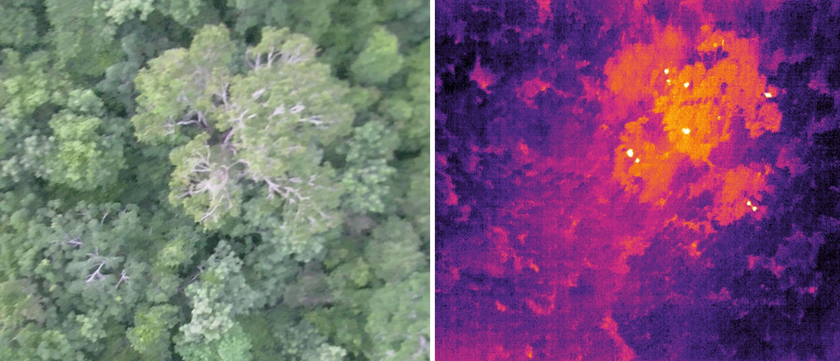
Astronomers regularly identify stars from infrared images and this astronomical technique can be used to study endangered species and their environments. Current conservation efforts often involve estimating endangered species through physical counts and from evidence they leave behind. This can lead to vast approximations due to human error, migrations, inaccessible landscapes and behavioural assumptions. These approximations are not only inexact, but they often lead to resource hungry projects. This is where astronomy stepped in, thermal imaging cameras, using the same infrared technology used to study stars, are mounted on drones. This imaging technique can identify not only animals but also people involved in poaching activities, day or night. Claire’s work in this area has caught the attention of international conservation organisations including ZSL, WWF and Durrell taking her across the world looking at orangutans in Borneo, spider monkeys in Mexico and lemurs in Madagascar. In this blog, Claire sheds some (infrared) light on her research and her journey from space back down to earth.
How did the opportunity arise for you to apply your knowledge to the study of endangered species?
Astro-ecology began with a chat between neighbors, ecologist Serge Wich and astrophysicist Steve Longmore. Serge was explaining the challenges of monitoring wildlife and how he wanted to solve the problem using drones, and how adding thermal cameras could be even better for finding animals in the dark or hiding in vegetation. But there were problems with this as well, the thermal infrared data was hard to interpret, and the sheer quantity of data generated took hours to analyse. Steve realised that these were problems that already have solutions in astrophysics. In infrared images animals glow like stars and galaxies, so we could use astro-techniques to find them automatically, and astrophysicists have been doing dig data science for decades. A collaboration was born, and they needed somebody to make the astro-ecology system a reality. With my background in infrared astronomy, and experience in environmental science I was lucky to be the person for the job.
You also worked in the met office on climate science, how does this fit in with remote sensing?
One of the first challenges I came across when trying to use thermal infrared cameras on drones was that in many of the tropical parts of the world where endangered animals are found, its often hot. In the middle of the day the sun can heat up the ground to temperatures similar to that of the animals themselves - its like trying to look at stars during the daytime. From my climate science days I recalled that we have been monitoring the Earth's temperature by satellite for decades, so I was able to apply the satellite data to make better observations of animals in warm parts of the world. The understanding of atmospheric processes that I gained from my years as a climate scientist turned out to be a major advantage when it came to knowing how best to find animals from a drone.
You have previously discussed your utilisation of captive animals to capture thermal profiles of species to aid with algorithms for AI development of the project. What is one of the biggest differences you have found from the application of your research in zoos and then in the wild?
To train our AI (machine learning) algorithms to recognise different animals we need to show it lots of examples of the animals we want it to be able to identify. Its really expensive to do this abroad, so we go to the local safari park instead. The most obvious difference is that the weather here in the UK is much cooler than it is in the South African savannah. So we can generally see the animals more clearly - they are much warmer than their surroundings here, meaning we have to think more about the physics and environmental differences in the places where they are found in the wild. The other big difference is that the animals in the safari park are totally habituated to the presence of humans and vehicles. At the safari park the animals don't notice the drone at all, but in the wild they can sometimes be skittish, so we have to deploy the drone carefully at first and take careful notice of the animals' responses.

Do you feel the drones will increase the safety of park rangers?
Hopefully yes. Around 200 rangers a year are killed by poachers in the line of duty. By sending out the drone to find the poachers instead this will help the rangers stay safe, and decreases the chance of a person stumbling across a poacher in the dark.
Do you worry about the demonization of poachers in general media, and how your work may potentially feed into this in the future?
Poaching is not a simple issue of good guys versus bad guys. Most poachers are poor locals who are just trying to make money to survive. Its not the individuals who we should be demonizing, rather the organised crime which drives it. Hopefully the presence of drones will act as a major deterrent to those who would be tempted to take money to kill endangered wildlife. As part of our aims when deploying the astro-ecology drones, we plan to engage local communities so we can raise technological skills and give people more opportunities for their futures.
Once your technology is widely available to conservation practitioners what will stop it falling into the wrong hands? If it becomes available to a wider market do you think it could be utilised by criminal organisations orchestrating the poaching of endangered species?
Most of the people who kill animals do so to be able to afford to support themselves and their families - they certainly can't afford to buy a drone. Upon completion, we will only provide the automatic detection system to trusted partners (for free/ at cost). We're not aiming to commercialise the software and put it on the market.
You have been extremely successful in your career so far and are a clear inspiration for other women in science, what advice would you give to other young scientists?
When you find something that interests you and you are passionate about, give it 100%. And it's ok to be interested in a lot of different things. Doing anything new or worthwhile isn't easy, but hard work really pays off. Follow your passion and it will take you to fantastic places.
I would like to extend thanks to Dr. Claire Burke for her enthusiastic cooperation with this blog and encourage you to visit her website to find out more about her research.
Amy van Gelder



Comments